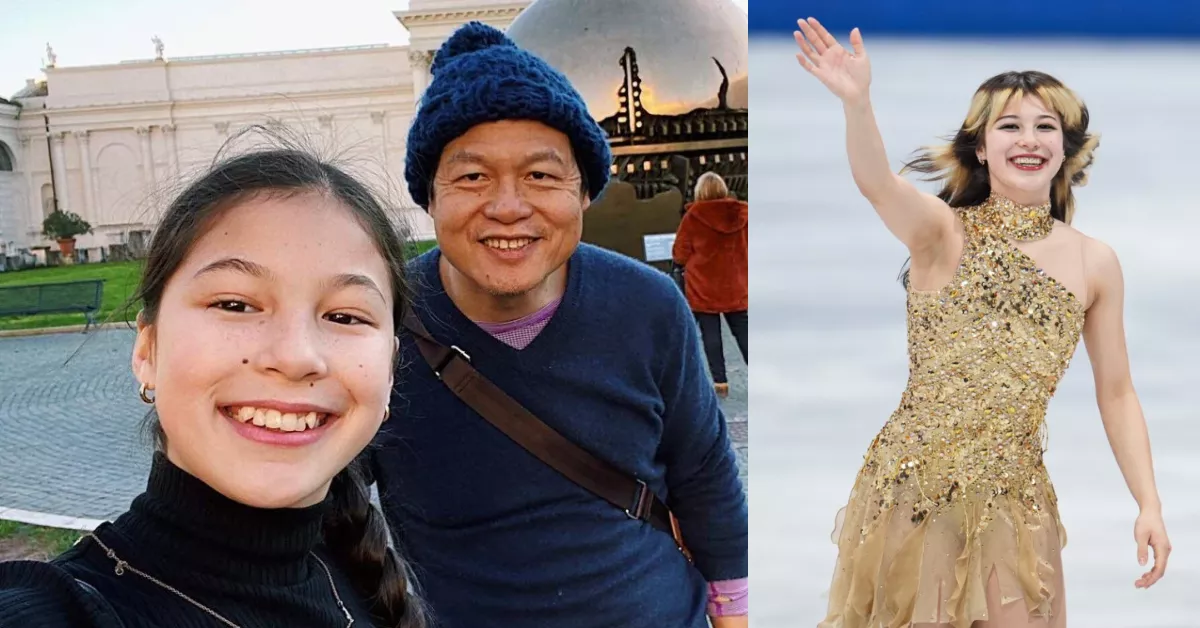
Alysa Liu won Olympic gold in Milan Cortina 2026, and her rise, from prodigy to a shocked retirement and back again, has a family story that surprises many.
She was born via anonymous egg donor and carried by a surrogate, and the people who raised her are central to the story people see on the ice today.
Her father, Arthur Liu, is the public face of that family story. He emigrated to the United States after taking part in the 1989 Tiananmen Square protests, became an attorney, and built a home where he raised five children using surrogacy and anonymous donors.

He has repeatedly described his role as hands-on. In a 60 Minutes interview, he said, “I spared no money, no time.”
Alysa also grew up with Yan “Mary” Quinxin, Arthur’s former wife, who served as a mother figure in the household.
Alysa has said she realized as a child that her family looked different and later learned the truth about donors and surrogacy.
That private arrangement has stayed private, and the anonymous donor and surrogate have not been publicly identified.
Alysa’s skating track record is now well known. She was a prodigy who began skating at five, became the youngest U.S. women’s champion at 13, and competed at the 2022 Beijing Olympics at 16.
After Beijing, she stepped away from the sport, citing burnout and trauma, and avoided the rink for a time. The break let her regroup.
She returned to competition with greater control over her programs and training and reached a new peak in 2025 and 2026.
Her comeback reached its highest point at the 2026 Winter Olympics, where she won the women’s singles gold medal and helped Team USA win gold in the team event. Commentators called her free skate near flawless and noted the emotional arc from prodigy to champion.

“I’m grateful for both Olympic experiences but I feel like I am more gracious now,” she said after competing, describing a different mindset than in 2022.
From the 60 Minutes profile and other interviews, we have direct words that show how Alysa thinks about skating and family.
She said, “I love struggling, actually. It makes me feel alive.” She also described wanting more input into her training and programs and said she “refuse[s] to not choose my own destiny.”

Those lines explain why her return was framed around personal agency as much as athletic goals.
The family has also weathered dangerous attention. During the 2022 Olympics, Arthur said he and Alysa had been targeted in an alleged spying operation, an episode he linked to his political past and which raised safety concerns at the time.

He told reporters he worried for their safety but intended to keep living openly.
If the question “who is her mother” is meant to find a single biological parent or a public maternal figure, the short answer is that there is no named biological mother in the public record.
Alysa’s upbringing came through surrogacy and anonymous donation, raised by Arthur and shaped in daily life by Mary Quinxin.
That combination produced a stable, if unconventional, household that delivered both pressure and protection for a child who would become a global athlete.
Why this matters now is easy to see. Alysa’s story touches on modern questions about how families are formed, how elite sport funding and parental involvement work, and how athlete welfare and identity intersect.
Her father’s financial and managerial role was enormous. He said he spent half a million to a million dollars on her career, and he was deeply involved in coach choices and logistics.
At the same time, Alysa’s more recent interviews emphasize that she returned because she wanted to, not because someone else demanded it.









Leave a Comment