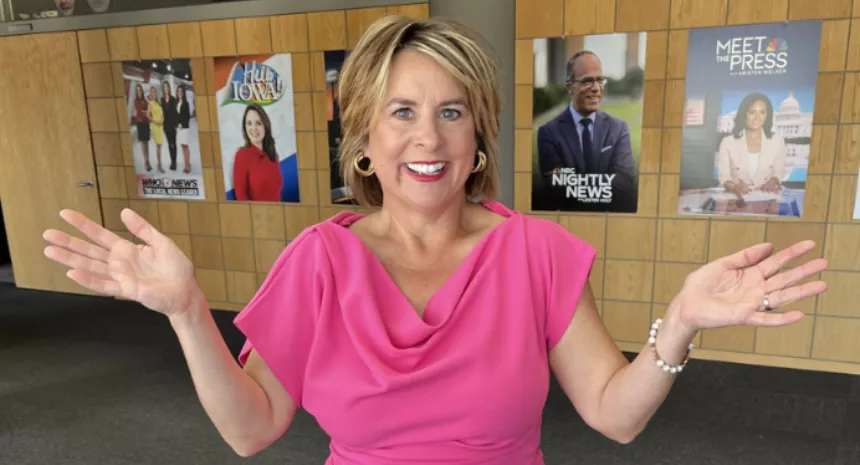
Jeriann Ritter has gone public about a serious and rapidly evolving health problem that is affecting the one skill central to her life and work.: speaking.
Ritter, a familiar face on WHO‑13 News since 2004, told viewers and colleagues in a Feb. 24 interview that doctors have warned her condition is “kinda bad” and that she is being evaluated for a progressive neurological disorder that appears to be affecting her speech, with some clinicians concerned it may be a bulbar form of ALS.
She first noticed subtle changes in her voice in October 2025 and, after a dentist raised concerns that the symptoms could be stroke-related, entered a months-long process of referrals and tests that culminated in a neurologist’s assessment.

Ritter has been frank about the emotional toll: she said she was unprepared for the news and described moments of denial and grief, but also a commitment to make the most of her time with family.
“I didn’t forecast this storm hitting. It’s raining right now, and I’m just trying to find the sunshine,” she told interviewers, adding that she wants to “finish this race strong.”

Viewers began noticing changes in her on-air delivery late last year, and Ritter acknowledged in a January social media post that she had been struggling with her voice and was seeking medical help.
In the televised segment, she explained that initial attempts at speech therapy produced mixed results; some exercises can relax muscles but carry the risk of accelerating weakness in certain conditions.
Because of that, her medical team is weighing options while she documents her speech over time, partly so clinicians can chart progression and partly so she retains a record of her decades of work on air.

Ritter’s situation has highlighted the particular vulnerability of broadcast professionals whose livelihoods depend on clear, reliable speech.
Colleagues at the station and longtime viewers responded with an outpouring of support after the interview aired; social posts and messages have poured in from people who say Ritter brightened their mornings for years.
She spoke movingly about those connections, recalling a viewer battling cancer who once asked her what brought her joy; her answer now is simple: living for the moment, faith, and family. That sense of purpose underpinned her decision to speak openly about her health.

Medically, what Ritter faces is complex and still formally unconfirmed in public records. Bulbar-onset motor neuron disease affects the muscles of the face, mouth, and throat first, which can change speech and swallowing long before other symptoms appear.
Ritter’s doctors reportedly observed signs consistent with bulbar involvement, prompting concern that the condition could be progressive.
She and her team have not released a formal diagnostic report, and Ritter herself has said she still hopes clinicians are wrong.

Until specialists publish definitive findings or Ritter and her doctors provide fuller medical statements, specifics about diagnosis and prognosis remain private.
The personal element of Ritter’s message was unmistakable: she wants to spend whatever time she has with people she loves, and she wants to continue living fully.
That determination comes with practical realities; broadcasting jobs require clear speech, and Ritter acknowledged the likelihood that her role on the weather desk will change.

She said she plans to record herself and keep a public record of how her speech evolves, both as a clinical aid and as a way to preserve the work that has defined much of her adult life.
Ritter’s candour has resonated with many who know someone affected by neurological disease. Public reactions have mixed sadness with gratitude: sadness at the prospect of a talented broadcaster facing a life-changing diagnosis, gratitude for her willingness to share a difficult, private journey in public.
For now, Ritter’s immediate focus is family and support; she spoke of the comfort of loved ones and the steady presence of colleagues who have posted memories and prayers.
As the story develops, Ritter has asked for privacy around medical details while expressing openness to sharing updates when she can.
Her case is a reminder of how subtle health changes can signal serious underlying problems and how public figures can use their platforms to raise awareness without turning private medical care into a spectacle.

For viewers who have followed her career, the hope is that advances in care and the support of a tight-knit community will sustain her through whatever comes next.
If Ritter or her medical team releases further information, updates will clarify diagnosis, treatment options, and how her role at the station may change.
Until then, she has asked for kindness from the public and promised to keep living and loving as she navigates an uncertain path.
Des Moines readers and longtime viewers continue to send messages of support to a broadcaster who has been part of their daily routine for years.











Leave a Comment