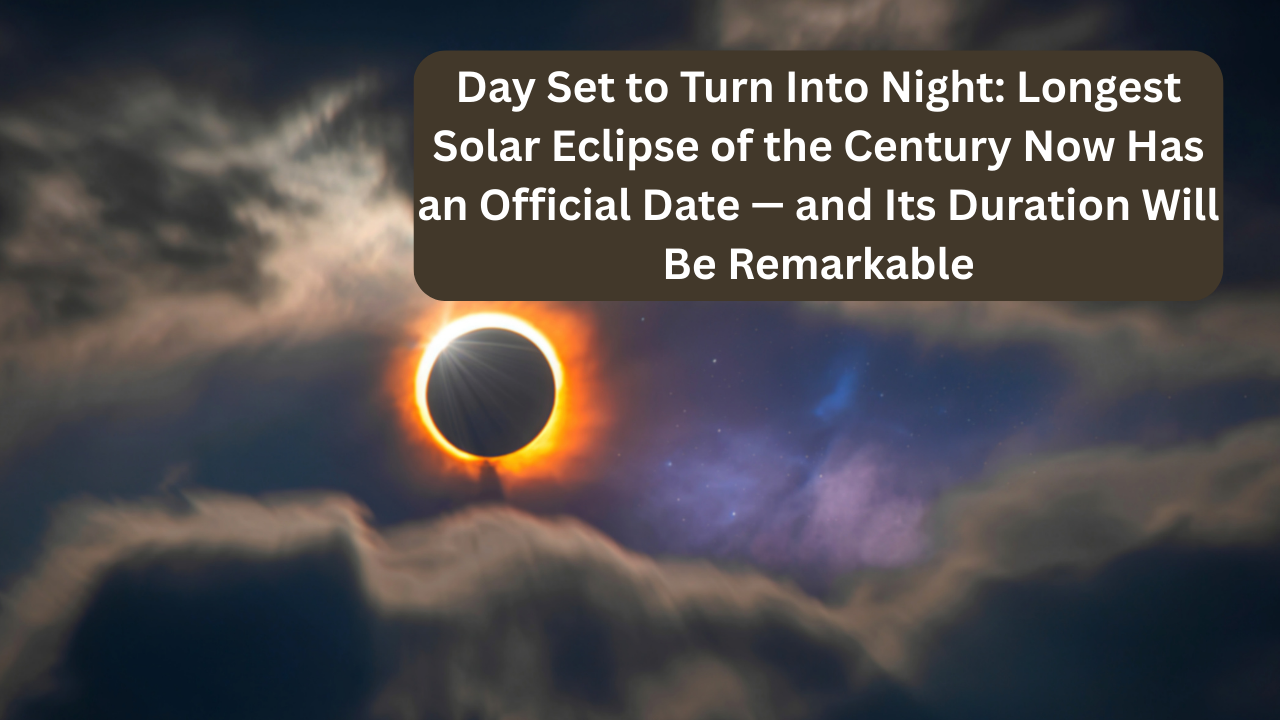
For a few extraordinary minutes, daylight will fade, temperatures will dip, and the sky will darken as if night has arrived early. Astronomers have now confirmed the official date of the longest total solar eclipse of the 21st century, and its duration is expected to be unlike anything most people have ever experienced.
Unlike shorter eclipses that pass in a flash, this one will linger — long enough for stars to appear, wildlife to react, and millions of people to witness a rare natural spectacle that won’t be repeated for generations.
Here’s what makes this eclipse so special, when it will happen, and why scientists around the world are already preparing.

The Official Date Has Been Confirmed
Astronomers have confirmed that the longest total solar eclipse of the century will occur on 2 August 2027.
On that day, the Moon will pass directly between the Earth and the Sun, perfectly aligning to block sunlight and plunge parts of the planet into temporary darkness.
What sets this eclipse apart is not just its visibility — but how long totality will last.

Why This Eclipse Is So Rare
Most total solar eclipses last only two to three minutes at most. This one is different.
At its maximum point, the 2027 eclipse is expected to last over six minutes of total darkness, making it the longest total solar eclipse visible from land between 1991 and 2114.
This happens because:

- The Moon will be near its closest point to Earth
- The Earth will be near its farthest point from the Sun
- The alignment will be almost perfectly centred
Together, these conditions stretch totality to near its theoretical maximum.
Where Day Will Turn Into Night
The path of totality will stretch across parts of:
- Southern Europe
- North Africa
- The Middle East
Major population centres will fall directly under the eclipse path, meaning millions of people will experience full darkness without travelling far.

Areas outside the path will still see a partial eclipse, but only those within the narrow band will experience complete blackout.
What People Will Experience During Totality
When totality begins, the change is sudden and dramatic.
Observers can expect:

- Rapid dimming of daylight
- A noticeable drop in temperature
- Birds and insects behaving as if night has fallen
- Bright stars and planets becoming visible
- The Sun’s corona glowing around the Moon
For more than six minutes, the sky will resemble twilight or early night — an unusually long time for an eclipse.
“It’s long enough for people to really absorb what’s happening,” said one astronomer involved in eclipse modelling.
“You’re not rushing to look. You’re living inside the event.”
Why Scientists Are So Excited
The extended duration makes the eclipse especially valuable for research.

Scientists plan to study:
- The Sun’s corona and magnetic field
- Solar wind behaviour
- Effects on Earth’s upper atmosphere
- Changes in temperature, wind, and animal behaviour
Longer totality means more data, better images, and deeper observations that are impossible during short eclipses.
How Often Do Eclipses Like This Happen?
Extremely long total solar eclipses are extraordinarily rare.

While solar eclipses occur somewhere on Earth every year or two, eclipses lasting more than six minutes:
- Happen only a few times per century
- Require near-perfect orbital conditions
- Often occur over oceans rather than land
That’s why the 2027 event is already being described as once-in-a-lifetime for many regions.
Safety Still Matters — Even During Darkness
Despite the excitement, eye safety remains critical.

It’s important to remember:
- You must use certified eclipse glasses during partial phases
- Only during full totality is it safe to look without protection
- As soon as sunlight returns, protection must be worn again
Because this eclipse lasts longer, experts warn people not to become complacent.
How People Are Already Preparing
Hotels, tour operators, and observatories along the eclipse path are already seeing interest — years in advance.
Many families and schools are planning trips specifically to witness the event, while scientists are organising international observation teams.
For those within the path, simply stepping outside could be enough to witness history.
Questions and Answers
1. When is the longest solar eclipse of the century?
2 August 2027.
2. How long will totality last?
Over six minutes at its maximum.
3. Why is it so long?
Because of near-perfect alignment and orbital distances.
4. Will it be visible worldwide?
No — only regions within the path of totality will see full darkness.
5. What happens outside the path?
A partial eclipse will be visible.
6. Is this the longest eclipse ever?
No, but it’s the longest of this century visible from land.
7. Is it safe to watch?
Yes — with proper eye protection.
8. Will animals react?
Many do, behaving as if night has fallen.
9. Will temperatures drop?
Yes, often noticeably.
10. Do I need special equipment?
Only eclipse glasses for safe viewing.
11. When is the next one like this?
Not for many decades.
12. Why is it such a big deal?
Because most people will never see an eclipse this long again.
Why This Eclipse Will Be Remembered
Solar eclipses are always impressive — but this one is different. Its length allows people not just to witness the darkness, but to feel it. To notice the silence, the cooling air, and the strange calm that settles in.
On 2 August 2027, for a few unforgettable minutes, day really will turn into night — and for millions of people, it will be a moment they talk about for the rest of their lives.











Leave a Comment