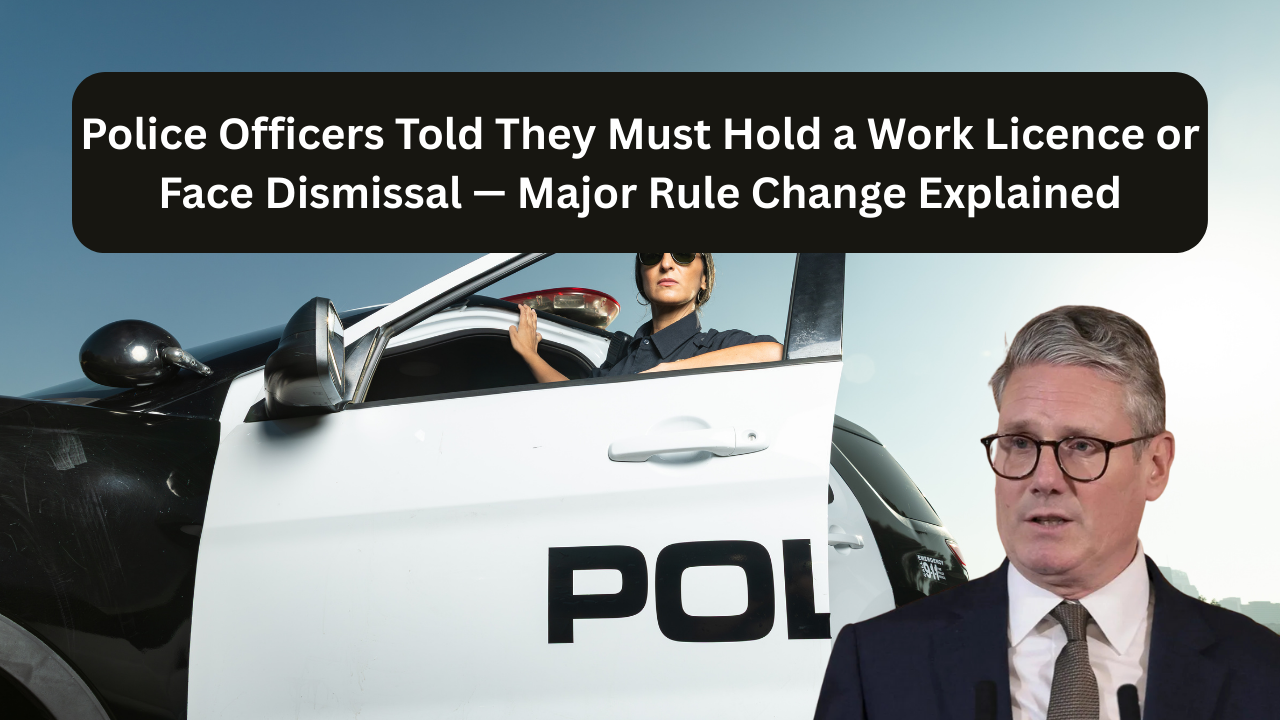
For years, police officers have assumed that once they passed training, their right to serve was secure unless they committed serious misconduct. That assumption is now being challenged. Under a new rule being rolled out across the UK, police officers who fail to hold — or keep — a valid work licence could face suspension or dismissal.
The move marks one of the biggest cultural shifts in policing oversight in decades, with supporters calling it overdue accountability and critics warning it could deepen recruitment and morale problems.
Here’s what’s changing, why it’s happening, and how it could affect officers on the ground.

What the New Rule Requires
Under the new framework, police officers will be required to maintain an active professional licence confirming they meet conduct, competence, and integrity standards.
If an officer:
- Loses their licence
- Fails to renew it
- Is deemed unfit to hold it
they may no longer be legally allowed to work as a police officer.
In practical terms, no licence means no job.
Why This Change Is Being Introduced
The rule follows years of criticism over how officers accused of misconduct remain employed for long periods while investigations drag on.
The licensing model is designed to:

- Speed up accountability decisions
- Prevent officers with serious concerns from staying on duty
- Align policing with professions like teaching and medicine
- Restore public trust after high-profile failures
A senior policing source said the aim is simple:
“Policing should be a profession, not a role you keep by default.”
Who Will Control the Licence
Licensing standards are overseen nationally, with forces applying them locally under guidance from College of Policing.
The licence would assess:
- Professional conduct
- Fitness to practise
- Ethical standards
- Ongoing suitability for policing powers
Losing the licence would automatically trigger employment consequences.
What Happens if an Officer Loses Their Licence
If a licence is withdrawn or suspended:
- The officer may be removed from duties immediately
- Pay may be affected depending on circumstances
- Dismissal proceedings can begin
- Reinstatement is not guaranteed
Supporters say this closes loopholes that previously allowed officers to remain employed despite serious concerns.
Why Some Officers Are Worried
Police federations have raised concerns about fairness and consistency.
Officers fear:
- Decisions could be rushed
- Standards may be applied unevenly
- Mental health or stress-related issues could be misinterpreted
- Appeals may be limited
One serving officer, speaking anonymously, said:
“It feels like another layer of pressure in an already intense job.”

Supporters Say It’s Long Overdue
Victims’ groups and reform advocates argue the system is essential.
They point out that:
- Police officers hold extraordinary powers
- Public confidence depends on trust
- Delayed misconduct outcomes damage legitimacy
- Other professions already use licensing systems
From this perspective, policing has been an outlier — until now.

Before vs After: Policing Accountability
| Area | Before | Under New Rule |
|---|---|---|
| Employment security | High by default | Linked to licence |
| Misconduct cases | Often lengthy | Faster outcomes |
| Oversight | Internal-heavy | Licence-based |
| Removal from duty | Slow | Immediate in some cases |
| Public confidence | Fragile | Aimed to improve |
The shift places professional status at the centre of policing.
What This Means for the Public
For the public, the change is meant to provide reassurance.
In theory, it means:

- Officers must continually prove suitability
- Problem cases are resolved faster
- Standards are enforced nationally
- Trust is built through transparency
However, critics warn that losing experienced officers could worsen response times if not managed carefully.
Questions and Answers
1. Is this rule already in force?
It is being implemented in stages across forces.
2. Does every officer need a licence?
Yes, under the new framework.
3. Can an officer be sacked without misconduct?
If they cannot legally hold a licence, dismissal may follow.
4. Who decides if a licence is withdrawn?
Decisions follow national standards with local application.
5. Is there an appeal process?
Yes, though details vary by case.
6. Does this apply to new recruits only?
No — serving officers are included.
7. Could this affect officer numbers?
Potentially, especially in the short term.
8. Is this about misconduct only?
Primarily, but suitability and fitness also matter.
9. Are other professions licensed like this?
Yes — teaching, healthcare, and law already use similar systems.
10. Will this improve public trust?
Supporters believe it will.
11. Are unions opposing it?
They support standards but want stronger safeguards.
12. What’s the biggest concern?
Ensuring fairness and consistency in decisions.
Why This Matters Now
At a time when policing faces scrutiny from all sides, this change redraws the relationship between authority and accountability. For officers, it raises the stakes of professional conduct. For the public, it promises clearer standards and faster consequences.
Whether it rebuilds trust or deepens tension will depend not on the rule itself — but on how fairly it’s enforced.






Leave a Comment