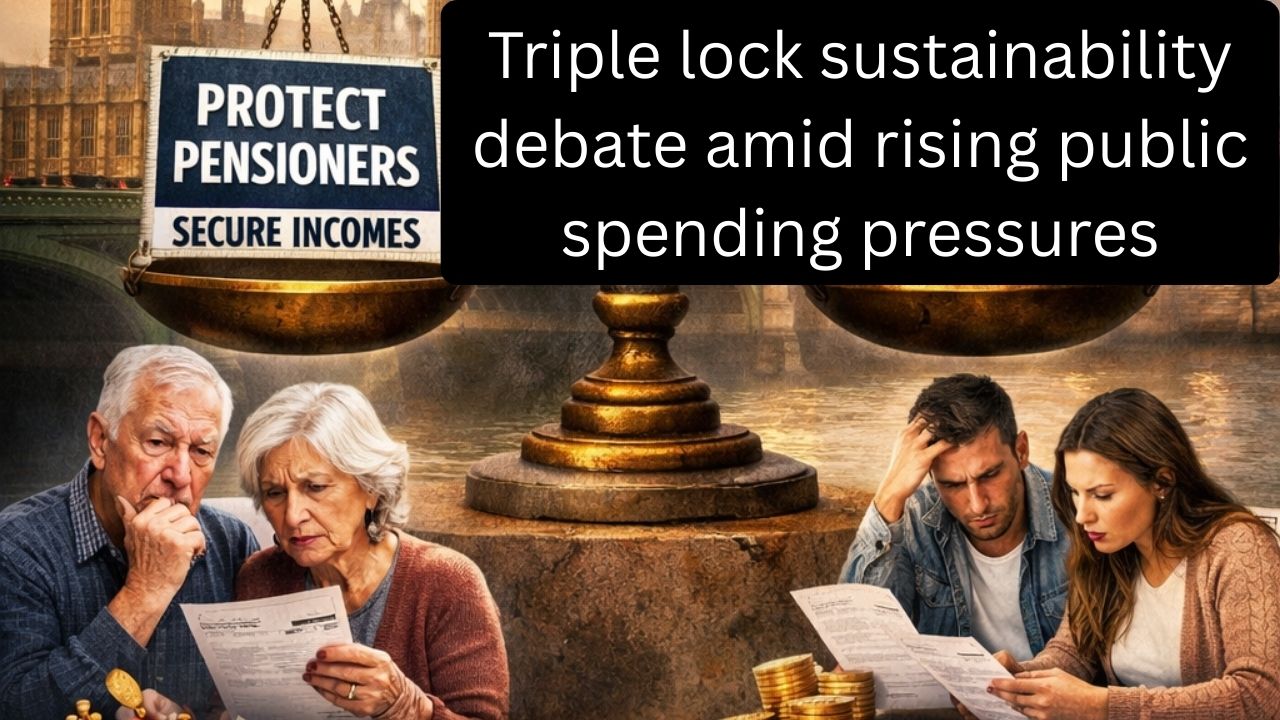
For more than a decade, the triple lock has been presented as a promise — a safeguard that the State Pension would not fall behind the cost of living or rising wages. But as public spending pressures intensify and government finances tighten, that promise is once again at the centre of a heated national debate.
With billions added to annual pension costs and competing demands from health, defence, and social care, policymakers are increasingly questioning whether the triple lock remains sustainable in its current form.
Here’s what’s driving the debate — and what it could mean for pensioners.

What Is the Triple Lock and Why It Matters
The triple lock guarantees that the UK State Pension rises each year by the highest of three measures:
- Inflation
- Average earnings growth
- 2.5 percent
Introduced in 2010, the policy was designed to protect pensioners from falling behind working households and to reverse decades of declining pension value.
Since then, it has played a major role in lifting pensioner incomes and reducing pensioner poverty, particularly among those who rely heavily on the State Pension.
Why Sustainability Is Being Questioned
The main issue is cost.
State Pension spending has risen sharply in recent years and now exceeds £120 billion annually, making it one of the largest components of public expenditure. Each one-percentage-point increase driven by the triple lock adds billions to future government commitments.
At the same time, the UK faces:

- Higher debt interest costs
- Rising NHS and social care spending
- Long-term demographic pressures from an ageing population
Chancellors from multiple governments have warned that the triple lock, while popular, creates unpredictable and compounding costs during periods of high inflation or wage volatility.
Public Spending Pressures in 2025
The debate has intensified as the government seeks to balance fiscal discipline with political commitments.
Spending reviews now show that age-related costs are rising faster than tax revenues. Treasury officials have privately described the triple lock as one of the most difficult policies to plan around, because it limits flexibility during economic shocks.

A senior official at HM Treasury summarised the challenge:
“The triple lock delivers certainty for pensioners, but it also transfers economic risk directly onto the public finances.”
Government Position So Far
Ministers continue to state that they are committed to the triple lock, at least in the short term.

A spokesperson for the Department for Work and Pensions said:
“The triple lock has been vital in protecting pensioners’ incomes and will remain in place while we continue to assess long-term affordability.”
However, the wording has become more cautious in recent years, with repeated references to “reviewing sustainability” rather than offering permanent guarantees.

Expert Analysis: The Core Arguments
Economists and pension specialists are divided.
Supporters argue:
- Pensioners are disproportionately affected by inflation
- The State Pension remains modest by international standards
- Stability builds trust in the system
Critics counter that:

- The triple lock grows faster than the economy over time
- Younger taxpayers carry a rising burden
- Other welfare benefits do not receive similar protection
Some analysts note that during periods of high inflation or wage spikes, the triple lock can lead to increases that outpace both prices and productivity, locking in higher costs permanently.
Alternatives Being Discussed
While no formal proposal has been announced, several options are frequently mentioned in policy circles:
- Replacing the triple lock with a double lock (inflation or earnings only)
- Suspending the earnings element during abnormal wage growth
- Linking increases to long-term averages rather than annual figures
- Introducing a cap on annual increases
Each option carries political risks, particularly among older voters.

Political Sensitivity and Public Opinion
The triple lock is one of the most politically sensitive pension policies in the UK.
Polling consistently shows strong public support for maintaining it, especially among retirees and those nearing pension age. Any suggestion of change often triggers backlash, even when framed as a technical adjustment.
This political reality has meant that successive governments have delayed reform, despite warnings from fiscal watchdogs.
What Pensioners Should Know
For now, the triple lock remains in force.
However, pension experts advise individuals to:
- Avoid relying solely on future State Pension increases
- Factor in potential policy changes when planning retirement income
- Monitor annual Budget and Autumn Statement announcements closely
The consensus is that while immediate changes are unlikely, long-term reform remains a real possibility.
Q&A: Key Questions Answered
1. Is the triple lock being scrapped in 2025?
No. It remains official government policy.
2. Why is it considered expensive?
Because it guarantees above-inflation increases during certain economic conditions.
3. How much does it add to spending each year?
Several billion pounds annually, depending on inflation and wage growth.
4. Has it ever been suspended?
Yes, elements have been temporarily adjusted in exceptional circumstances.
5. Does it apply to all pensioners?
It applies to the State Pension, not private pensions.
6. Why don’t other benefits have similar protection?
Most are uprated only by inflation or are frozen.
7. Could a future government change it?
Yes, through legislation.
8. Is the UK unique in having a triple lock?
Yes. Few countries offer such a strong annual guarantee.
9. Does the triple lock reduce pensioner poverty?
It has helped, particularly for those with limited private income.
10. Who benefits most from it?
Those who rely mainly on the State Pension.
11. Does it affect younger taxpayers?
Indirectly, through higher long-term public spending.
12. Is reform inevitable?
Many experts believe some change is likely over time.
13. Will changes happen suddenly?
Major reforms would likely be phased in.
14. Where are decisions announced?
Usually in Budgets or Autumn Statements.
15. What should people watch for next?
Government reviews on pension sustainability and public finances.









Leave a Comment