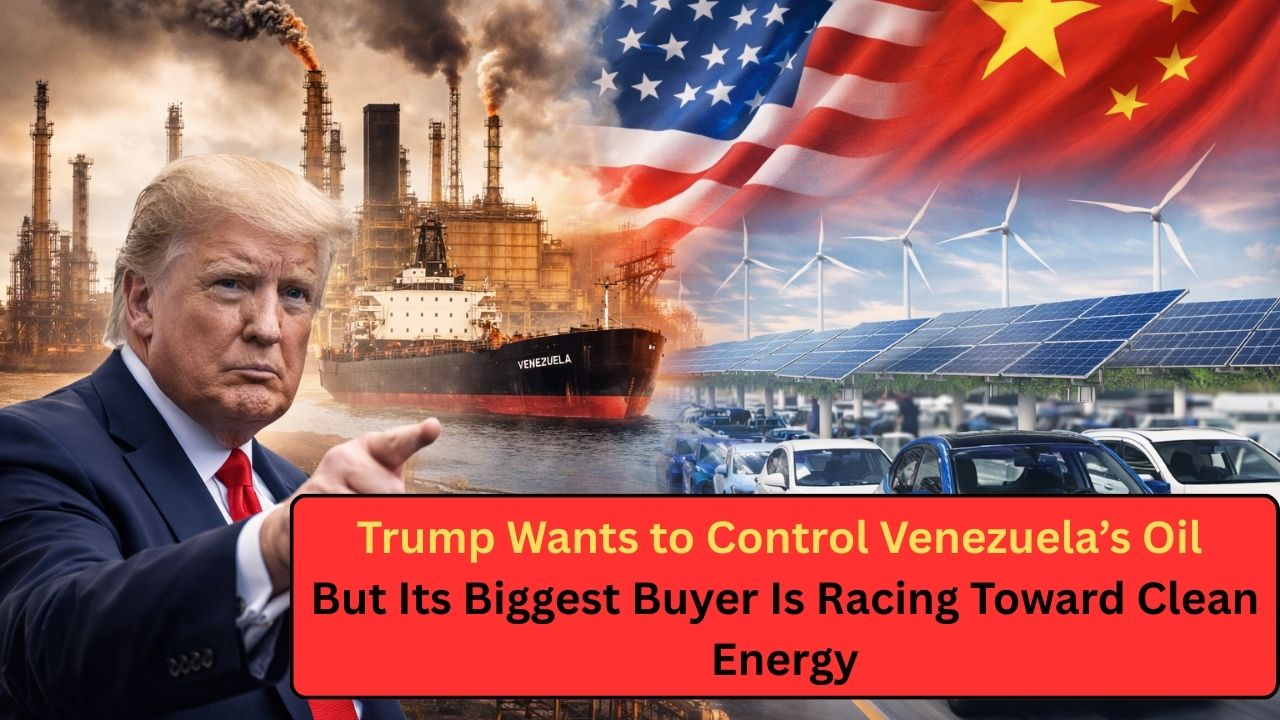
Former US president Donald Trump has repeatedly argued that Venezuela’s vast oil reserves should fall under US control or influence, framing the country’s energy wealth as a strategic prize for American power and global leverage.
From a UK perspective, however, the plan highlights a growing contradiction in global energy politics: Venezuela’s largest oil customer is rapidly moving away from oil altogether.
That customer is China, whose accelerating push toward clean energy and electric transport is reshaping global oil demand — and weakening the long-term value of oil-heavy strategies.

Why Venezuela’s Oil Is So Strategically Important
Venezuela holds the largest proven oil reserves in the world, larger than those of Saudi Arabia. For decades, this made it a central player in global energy markets.
Trump has argued that controlling or heavily influencing Venezuelan oil would:
- Strengthen US energy dominance
- Reduce reliance on rival oil producers
- Increase geopolitical leverage over global markets
Supporters see oil as a long-term asset of power. Critics say that view underestimates how quickly the energy system is changing.

China’s Role as Venezuela’s Biggest Oil Customer
For more than a decade, China has been Venezuela’s largest oil buyer, importing large volumes of crude and providing financial support in exchange for future oil shipments.
This relationship was crucial when Western sanctions limited Venezuela’s access to markets. However, China’s energy strategy has shifted dramatically in recent years.
China’s Clean Energy Acceleration
China is now the global leader in:

- Electric vehicle manufacturing and adoption
- Solar and wind power installation
- Battery production and energy storage
As a result, oil demand growth in China is slowing sharply, particularly for heavy crude like Venezuela’s, which is expensive to refine and carbon-intensive.
Energy analysts increasingly believe China is approaching — or has already reached — a peak in oil demand, with consumption expected to flatten and eventually decline.
A Strategic Mismatch
This creates a clear mismatch in global strategy:

- Trump’s approach: Focus on controlling oil supply
- China’s direction: Reduce dependence on imported oil
Even if the US gained influence over Venezuelan oil exports, China may no longer need them at the scale it once did. That reduces both the economic and strategic value of Venezuela’s reserves over the long term.
What This Means for Venezuela
For Venezuela, the shift is risky. Reviving oil production requires massive investment, but global investors are increasingly cautious about long-term fossil fuel projects.
If China continues to reduce oil demand while other countries accelerate clean energy transitions, Venezuela could face:

- Fewer long-term buyers
- Lower oil revenues
- Greater economic instability
Without diversification, its economy remains highly exposed to declining fossil fuel demand.
Why This Matters to the UK
From a UK standpoint, the situation reflects broader global trends:
- Oil remains geopolitically important in the short term
- Clean energy is reshaping long-term demand
- Countries heavily dependent on oil face growing uncertainty
The UK’s own push toward electric vehicles and renewable energy mirrors the direction China is moving — highlighting how global energy priorities are shifting away from oil-centred power.

Questions and Answers
1. Does Trump literally want to own Venezuela’s oil?
No. He has argued for US control or dominance over production and sales, not personal ownership.
2. Why is Venezuela’s oil so significant?
It represents the world’s largest proven reserves.
3. Who buys most Venezuelan oil?
China has been its largest customer for many years.

4. Why is China buying less oil long-term?
Because of rapid growth in electric vehicles and renewable energy.
5. Is oil demand falling globally?
Growth is slowing, especially in major economies.
6. Does this weaken Venezuela’s bargaining power?
Yes. Fewer buyers reduce leverage.

7. Can the US replace China as a buyer?
Partially, but not at the same long-term scale.
8. Why is heavy crude less attractive?
It is harder to refine and more polluting.
9. Is oil still important geopolitically?
Yes, particularly in the short to medium term.
10. Could clean energy make oil irrelevant?
Not immediately, but it is steadily reducing oil’s dominance.
11. What happens to oil-dependent countries?
They face higher economic risks without diversification.
12. Is China alone in this transition?
No, but it is moving faster than most countries.
13. Does this affect oil prices?
Slower demand growth can limit long-term price rises.
14. What should policymakers watch next?
EV adoption rates and renewable energy expansion.
15. Is this shift likely to reverse?
Most experts believe the clean energy transition is permanent.










Leave a Comment