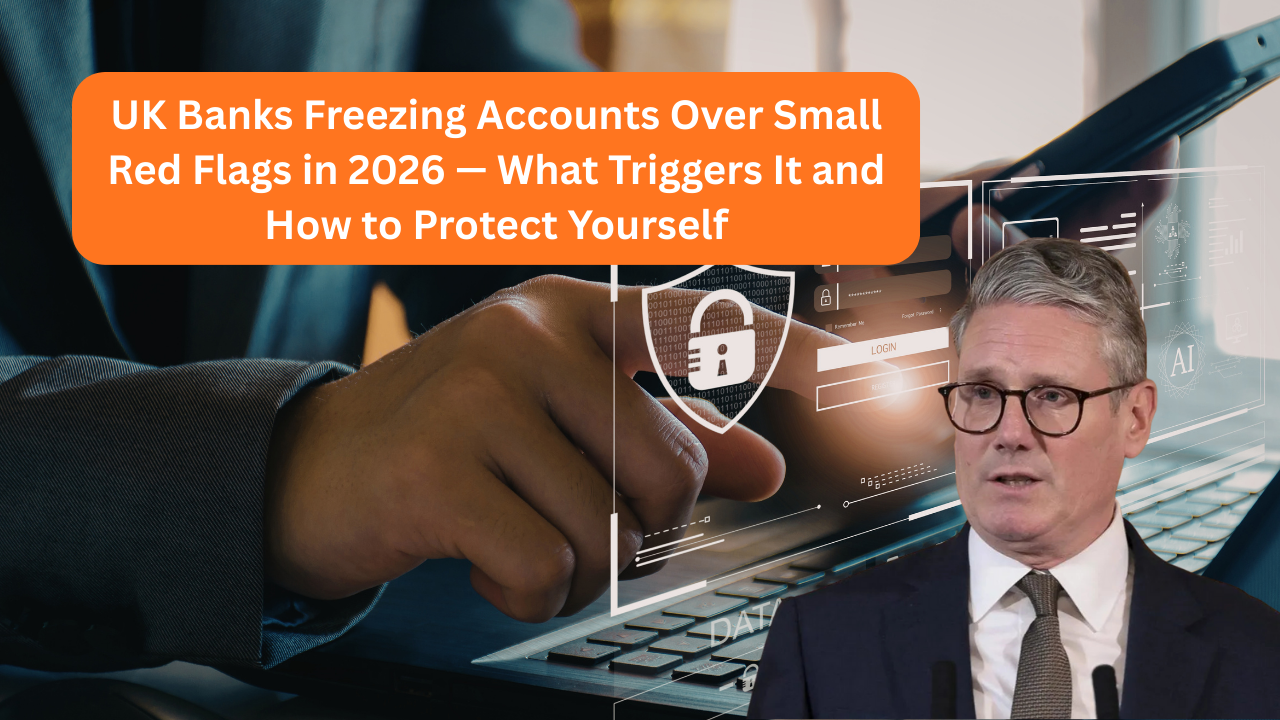
It often happens without warning. One minute your card works, the next it’s declined. You open your banking app and see a message saying your account is “under review.” Across the UK in 2026, more customers are discovering their bank accounts frozen over what feel like minor or harmless actions.
Banks say the freezes are about fraud prevention and legal obligations. Customers say they’re being locked out of their own money for days or even weeks — sometimes over transactions they didn’t realise were an issue.
Here’s what’s triggering these freezes, why banks are acting so fast, and what you can do if it happens to you.

Why Banks Are Freezing More Accounts in 2026
UK banks are under growing pressure to spot fraud, money laundering, and scam-related activity early. That has led to stricter automated monitoring systems, which flag unusual behaviour instantly.
Common reasons banks give include:
- Protecting customers from scams
- Meeting anti-money laundering rules
- Preventing financial crime
- Responding to suspicious transaction patterns
The problem is that automation doesn’t always understand context.

Small Red Flags That Can Trigger a Freeze
Customers report freezes triggered by actions that seemed ordinary at the time, such as:
- Receiving a larger-than-usual payment
- Moving money quickly between accounts
- Sending funds to a new payee
- Sudden changes in spending patterns
- International transfers, even small ones
- Multiple failed login attempts
In some cases, the account holder did nothing wrong — the system simply flagged the activity.
Real Stories From Locked-Out Customers
Rachel Moore, 37, from Oxford, had her account frozen after selling a used car.
“I received £6,200 in one payment and the next morning my account was blocked,” she said. “I couldn’t pay rent or buy food.”
In Glasgow, student Ahmed Khan had his account frozen after receiving money from family overseas.
“It was only £300. They said it was a routine check, but I couldn’t access anything for five days.”

What Banks Are Saying
Banks insist freezes are temporary and necessary.
A banking compliance officer said:
“If we don’t act quickly when something looks unusual, the consequences can be serious. Freezing is a safety measure, not a punishment.”
However, banks rarely give detailed explanations during a freeze, which adds to customer frustration.
How Long Do Freezes Usually Last?
There’s no fixed timeframe.
Some reviews are resolved within 24–48 hours. Others can take days or weeks, especially if:
- Documents are required
- Transactions involve overseas accounts
- Scam concerns are raised
- The case is escalated internally
During this time, access to funds can be severely limited.

What You Should Do If Your Account Is Frozen
If your account is frozen:
- Contact your bank immediately
- Ask what documents are needed
- Respond quickly and clearly
- Keep records of all communication
- Ask about hardship options if bills are due
Staying calm and cooperative can speed things up.
What Can Reduce the Risk of a Freeze
While freezes can’t always be avoided, you can lower the risk:
- Warn your bank before large or unusual transactions
- Keep contact details up to date
- Avoid rushing multiple transfers
- Be cautious with new payees
- Report scams or suspicious messages immediately
Transparency helps systems understand your activity.
Before vs Now: Banking Reality
| Area | A Few Years Ago | 2026 Reality |
|---|---|---|
| Monitoring | Mostly manual | Highly automated |
| Freeze triggers | Larger red flags | Smaller patterns |
| Communication | Slower but clearer | Faster, less detail |
| Review time | Predictable | Varies widely |
| Customer impact | Limited | Often severe |
Questions and Answers
1. Can banks freeze accounts without warning?
Yes. They are legally allowed to act immediately.
2. Is a freeze the same as account closure?
No. Freezes are usually temporary.

3. Can I access any money during a freeze?
Sometimes limited access is allowed, but not always.
4. Does this affect credit scores?
Not directly, but missed payments can have knock-on effects.
5. Are joint accounts affected?
Yes. The whole account may be restricted.
6. Can a small amount really trigger this?
Yes, if the pattern looks unusual.
7. Will the bank explain why?
Often only in general terms.
8. Should I move money elsewhere beforehand?
Moving funds suddenly can increase risk.
9. Can freezes happen more than once?
Yes, especially if patterns repeat.
10. What if bills are due?
Ask about hardship support immediately.
11. Are online banks worse for this?
All banks use similar monitoring rules.
12. Is this likely to increase further?
Experts say yes, as fraud pressures grow.
Why This Matters for UK Customers in 2026
With more people living month to month, losing access to money — even briefly — can cause real harm. While banks have legal duties, the human impact of freezes is becoming harder to ignore.
Understanding what triggers reviews and how to respond quickly could make all the difference if your account is suddenly locked.






Leave a Comment