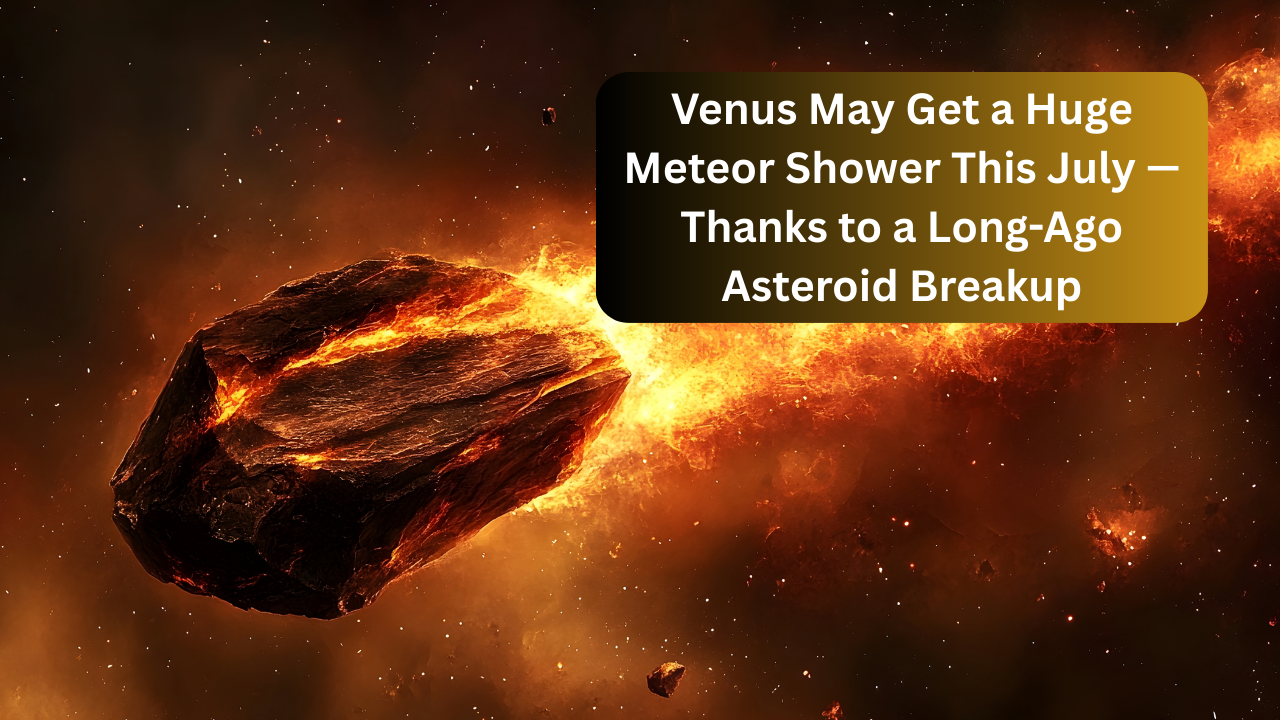
A dramatic celestial event may be unfolding far closer to the Sun than Earth ever sees. Astronomers say Venus could experience an unusually intense meteor shower this July, triggered by debris from an ancient asteroid breakup that happened thousands of years ago.
While the spectacle won’t be visible to the naked eye from Earth, scientists believe the event could briefly light up Venus’s skies — offering a rare opportunity to study how meteors behave on another planet.

What’s Expected to Happen
Researchers have identified a dense stream of space debris crossing Venus’s orbit in July, remnants of an asteroid that shattered long ago. As Venus ploughs through this debris cloud, countless small fragments are expected to slam into its atmosphere at extreme speeds.

Because Venus has a thick, dense atmosphere, even small particles can produce bright, energetic flashes — potentially creating one of the most intense meteor events the planet experiences in centuries.
The Ancient Asteroid Behind It All
The debris trail comes from a catastrophic asteroid breakup that occurred far back in the Solar System’s history.
Over time:

- The fragments spread out along the asteroid’s original orbit
- Gravity slowly reshaped the debris stream
- Portions of it now intersect Venus’s path
While Earth passes near this debris too, Venus’s orbit lines up more directly — placing it right in the firing line this year.
Why Venus Is Especially Vulnerable
Venus is uniquely suited to dramatic meteor activity:
- Its thick atmosphere causes intense friction
- Incoming meteors burn up violently
- Energy is released high in the clouds
- Even tiny particles can create bright flashes
On Earth, many of these fragments would burn quietly or go unnoticed. On Venus, they may produce short-lived but powerful light bursts across the planet’s night side.

Why We Won’t See It From Earth
Despite the excitement, this won’t be a skywatching event for backyard astronomers.
That’s because:
- Venus’s thick cloud cover blocks visible light from space
- The meteors occur on the planet itself, not in space around it
- The glare of the Sun makes close observation difficult
Instead, scientists rely on spacecraft instruments and indirect observations to detect the effects.
How Scientists Can Detect the Shower
Even without direct images, researchers can look for clues such as:
- Sudden flashes detected by orbiting probes
- Changes in Venus’s upper atmosphere
- Chemical signatures from vaporised meteors
- Brief temperature spikes in the mesosphere
These signals help confirm whether a meteor storm is actually taking place.
Why This Matters to Science
Meteor showers aren’t just pretty — they’re valuable.

Studying them on Venus can help scientists understand:
- How planetary atmospheres respond to impacts
- Differences between Earth-like and extreme atmospheres
- How often planets are hit by space debris
- The long-term effects of asteroid breakups
It also helps refine models predicting meteor storms on Earth and other planets.
Could This Happen Again?
Yes — but not often.

Dense debris streams:
- Disperse slowly over thousands of years
- Can cause brief bursts of activity when orbits align
- Rarely line up perfectly with a planet’s path
That makes this July’s Venus encounter unusual and time-specific, not a regular occurrence.
A Reminder of a Violent Solar System
Events like this highlight a reality we often forget:
the Solar System is not calm or static.

Asteroids break apart.
Debris drifts for millennia.
Planets plough through invisible minefields.
Venus’s possible meteor storm is a reminder that space history keeps unfolding — even now.
Questions Scientists Are Watching Closely
- How intense will the impacts be?
- How high in the atmosphere will they burn?
- Will chemical traces linger afterward?
- Could similar debris affect Earth in the future?
July’s data could help answer all of them.

Why This Event Is So Fascinating
Earth gets meteor showers regularly — but watching another planet experience one is far rarer.
If confirmed, this Venus event would be:
- One of the strongest predicted meteor showers on another planet
- A direct link between ancient asteroid destruction and modern planetary effects
- A natural laboratory for atmospheric science
Even unseen, it’s a powerful reminder that the Solar System is still shaped by its violent past.









Leave a Comment