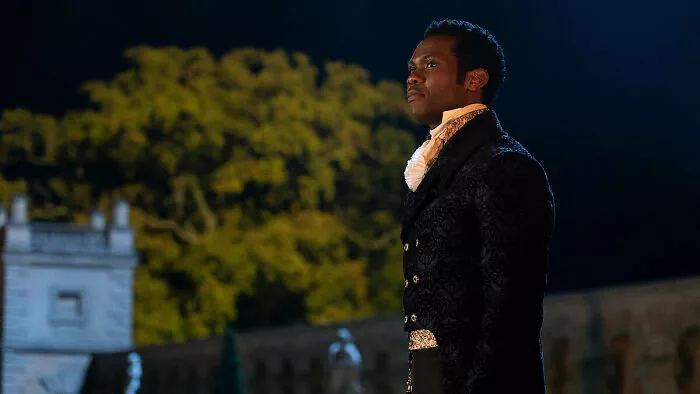
John Stirling is small in page count but large in consequence in Julia Quinn’s novels, and his sudden death is the quiet hinge on which one of the series most tender love stories turns.
In the books, he is not a flamboyant hero or a theatrical villain. He is steady, decent, and briefly luminous in Francesca’s life, and the abruptness of his passing is what gives the later romance that follows its real force.
In When He Was Wicked Francesca Bridgerton’s marriage to John is portrayed as quietly happy. Francesca is a character who has lived mostly in the background of her loud and loving family, and John offers a domestic normality she did not expect.

Their relationship is gentle, ordinary, and affectionate. That ordinary contentment is shattered when John dies suddenly from a brain aneurysm. There is no long illness, no drawn-out decline, no great public spectacle.
The death arrives as a single sharp rupture. Francesca is left a young widow, childless and bereft, and the novel traces the slow, complicated work of grief and healing that follows.
John’s death matters because it creates the space in which Michael Stirling enters the story as more than a friend. Michael is John’s cousin and quietly in love with Francesca long before anyone names it. With John gone, Michael inherits responsibilities, titles, and grief.

The two of them carry different forms of sorrow. Francesca mourns a life that was unexpectedly taken from her. Michael contends with guilt and a love that has always felt, in some measure, disloyal. The result is an adult courtship shaped by loyalty, regret, and eventual courage.
That grief-driven path to love is what makes Francesca’s story stand out among the Bridgerton romances. It is less about fireworks and more about repair.
Translating that compression of tragedy to the screen requires different tools. Television cannot simply tell readers that a death happened.

It has to make the audience feel, within minutes, why the loss matters. If the Netflix series Bridgerton adapts Francesca’s arc, expect the show to expand and to linger where the novel is concise.
Francesca’s marriage to John will be given texture in scenes that show domestic life, private laughter and the small gestures that make a relationship real.
When the death occurs the shock will be sharper because the audience has been invited into those small moments.

Netflix may choose several narrative approaches. One plausible route is to build John’s presence over an episode or two so that his sudden death lands with the force television demands.
That approach preserves the novel’s emotional logic, which depends on the abruptness of loss, while making the loss viscerally felt on screen.

Another option is to keep John mostly off camera and let the series dwell on the aftershocks of grief. That choice would mirror the book’s inward focus but risks less immediate audience investment in the marriage that has ended.
Michael’s role on screen is likely to be enlarged and introduced earlier. Television often asks viewers to see the future by giving them evidence now.
Showing Michael as a figure already entwined with Francesca before John dies heightens the moral complexity when his feelings come to the surface. It also gives actors richer material.

The push and pull between duty and desire, between mourning and new possibility, reads well on screen and would likely be a centerpiece of any Francesca-focused season.
The cause of John’s death, a brain aneurysm, is a detail that television writers may treat with caution. They could stage the collapse as a private medical emergency to preserve intimacy.
They might place it in public to dramatize the suddenness and to force other characters into immediate crisis. Either way the television version will use visual means to show how grief reorders social obligations, legal questions and the small humiliations and comforts that follow loss.

Any adaptation will also have to manage tone. Francesca’s story in the novels is restrained and interior. The screen tends to be more demonstrative.
The smartest approach would be to keep the emotional truth of the books intact by letting silence, gestures, and small domestic details carry the heft of loss. Showing Francesca alone in a quiet room, handling a mundane object that now means everything, can be as powerful as any big speech.
Above all, the essentials are unlikely to change. John will remain an essentially decent man. His death will be sudden and natural. Francesca will be left young and childless, and Michael will have to navigate inheritance and his own remorse before love can be offered without shadow.

Those bones of the story give Francesca’s courtship its seriousness and keep the novel from becoming simply another romantic comedy.
For viewers waiting for Francesca’s turn, the books make clear what the drama will need: a marriage shown with honesty, a death handled with respect, and grief depicted as a process rather than a plot device.
If the Netflix series follows those lines, the result should be a season that honors the quiet power of the original material while giving it the visual particularity television does best.










Leave a Comment