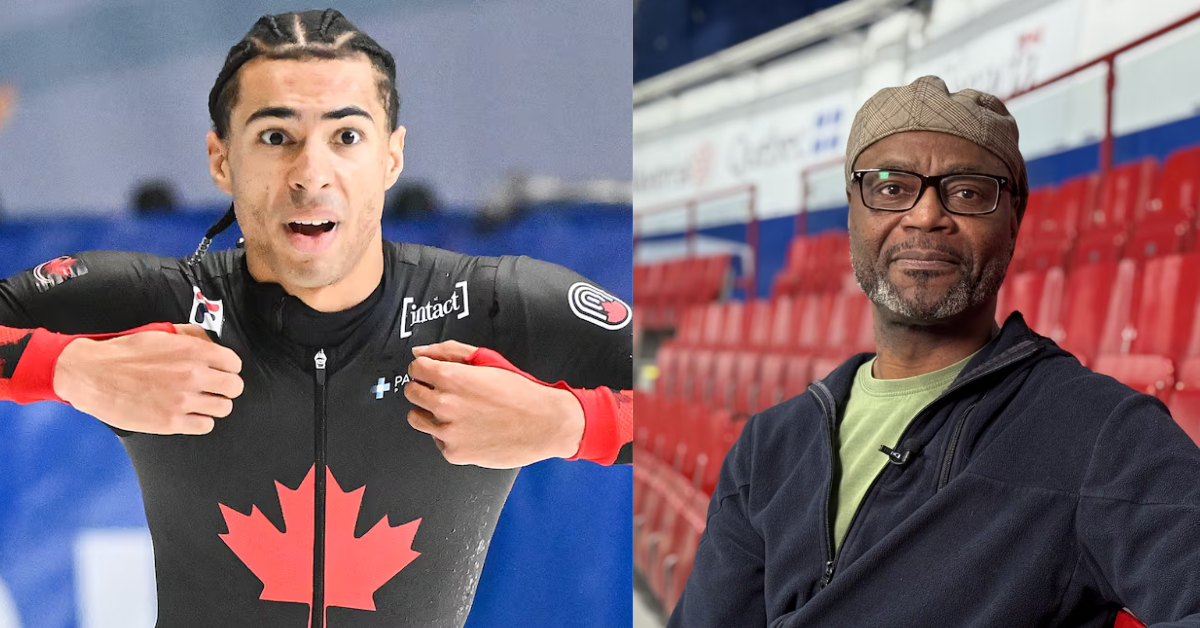
William Dandjinou, at the Milano Cortina 2026 Winter Olympics, a Montrealer whose origins and family helped shape one of short track’s most electrifying talents, arrived in Italy with high expectations and left asking fans to fall in love with the sport the same way he has.
William Dandjinou’s rise reads like a sprint: after a frustrating near-miss for Canada’s 2022 Olympic team that briefly made him question his future in the sport, the 24-year-old refocused and ripped through the World Tour, winning back-to-back Crystal Globes and reaching the podium 19 times in his last 30 races.
“It’s goosebumps, man,” Dandjinou said. “The opportunity that it represents for me to push my sport forward and actually showcase what short-track can be, that’s just amazing.”

The Olympics have shown both his speed and his range. On Feb. 12, he helped Canada take silver in the mixed relay, and later in the day, he pushed through heats and semifinals to reach the men’s 1,000-metre final, where he finished a heartbreaking fourth, just off the podium but never out of the conversation. It was a snapshot of Dandjinou’s season: relentless, threatening, and full of near-magic.
Canada’s short-track elders have noticed. “He’s probably, in his young career on the world circuit, the best skater in Canada — ever,” Charles Hamelin said, calling Dandjinou the fastest skater “in every sense.”

Hamelin, the six-time Olympic medallist, praised the way Dandjinou combines raw speed with tactical intelligence that forces rivals into mistakes. “He is the kind of skater that scares everyone else on the ice,” Hamelin said. “Makes people do mistakes … because they know that Will will either block them or outpunch them.”
Dandjinou’s physical presence is part of the story. At six-foot-three, he towers over many competitors in a discipline usually dominated by more compact athletes.
The size brings a tradeoff; tighter passing lanes are harder for a taller skater to exploit, and heavier frames can roughen poor ice, but William has turned his length into an advantage, using long legs and clever track patterns to control races.
“People are not used to it,” he said. “You can use angles differently … I can use my track patterns to block people a lot easier if I’m able to use my long legs, and it gets really dangerous for others because I can keep up the speed longer.”
That speed and personality have made him a fan magnet. He celebrates victories with a bird-flapping “eagle” move that he has trademarked and turned into merchandise.
In China, fans have dubbed him “Brother Bird,” and his ability to speak Mandarin has amplified his connection there.
But Dandjinou’s story is rooted in family. His parents, Alain Dandjinou and Mirabelle Kelly, are both microbiologists who met at university in Sherbrooke.
Alain immigrated from the Ivory Coast and, unfamiliar with winter sports, still put his young son on skates to make the most of Canadian winters, while Mirabelle was born and raised in Canada.
William began skating as a toddler, hockey first, then short track, and those early rides to distant competitions left an impression.

“He followed me throughout my whole career; he knows me more than a lot of my coaches do,” William said of his father. Alain will travel to Italy to watch his son compete at the Olympics for the first time, a moment William described as deeply meaningful.
The path has not been without doubt. After missing the 2022 Olympic cut, he spent months asking whether he loved the sport or was simply good at it.

“You start asking yourself questions like, ‘Am I doing this for the right reasons…?’ ” he said. The answer was to commit fully: “I wanted to be all-in and I had to make sure I was ready to be all-in and in a position where nothing was guaranteed to me.”
That decision paid off. Dandjinou’s trophy cabinet includes multiple world-championship medals and two straight Crystal Globes as the ISU World Tour’s top male skater.
He arrived in Milan with both momentum and a bold personal target: competing in three individual events and two relays, he floated the idea of a five-medal haul, ambitious but not impossible given the form he’s shown.

“Five is not unrealistic, but it’s very ambitious,” he said. “But I’m a very ambitious guy. I’ll do everything in my control to work on that.”
Coach Marc Gagnon, who has guided Canada’s program for years, believes the team is in its strongest position in decades and sees Dandjinou as a linchpin.
“Will has learned that. He’s never sitting on his laurels … If you talk to him about his success and the fact that he’s the strongest skater in the world, he will probably not even admit that,” Gagnon said.

Beyond medals, Dandjinou thinks bigger; he wants short track to be more than a niche winter sport.
He envisions semi-professional leagues, special events, and even new formats that could bring steady audiences.
“I see a picture where our sport could be one of the most-watched in the world,” he said, comparing skaters to Formula One drivers who generate speed without engines.
That vision, selling the thrill, unpredictability, and raw human power of short track, helps explain why his Olympic push feels like a broader campaign, not just for himself but for the sport.
There are cultural threads to his ascent, too. He cites role models like Shani Davis and Apolo Ohno and has become a rare global figure for the sport, able to connect with fans in multiple languages. He’s already left an impression on the next wave of skaters and on viewers who may be tuning in for the first time.
The 2026 Games will be telling. Dandjinou has already shown he can convert disappointment into performance and that his physical gifts, tactical mind, and appetite for spectacle can all coexist.
Whether he finishes with four medals, five, or a different tally, his presence is reshaping expectations for Canadian short track.
“Four years ago I didn’t even qualify for the Games and now I’m in a position where I can have the weight of the world on my shoulders,” he said. “I’ve been working, I say four years, but basically my whole life for moments like these. I just hope I can showcase how much short track is cool in those moments.”
If he does, Canada and a lot of new viewers may look back on Milan Cortina as the moment William Dandjinou helped lift a sport into the spotlight.







Leave a Comment